
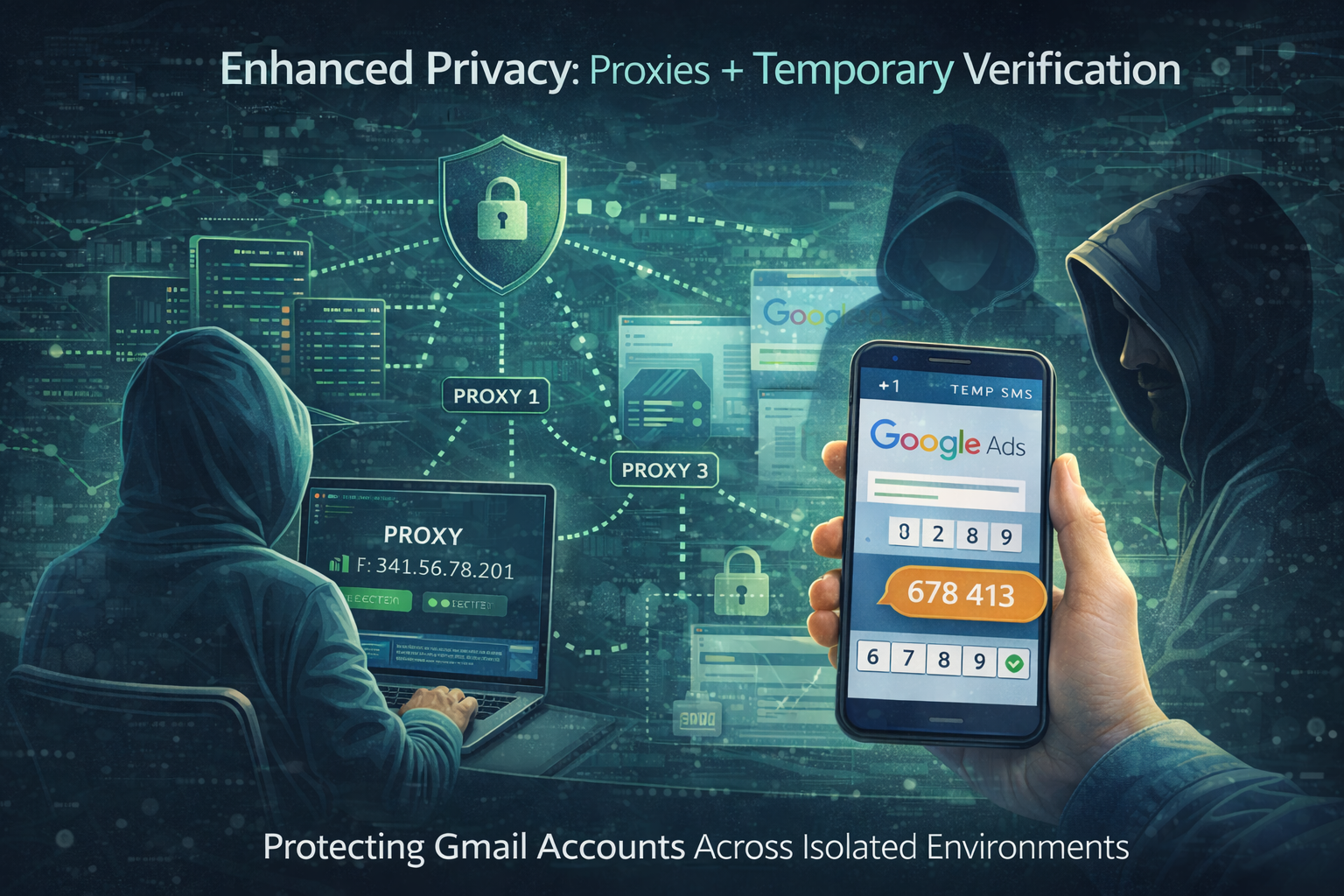
In the privacy ecosystem, isolation is a principle — not a preference.
Users who rely on proxy services understand that separating IP addresses protects identity layers, prevents tracking, and reduces cross-platform profiling. But IP separation alone is not enough.
Account verification channels often remain centralized.
When creating Gmail accounts under isolated environments, many users overlook one detail: phone verification.
Why IP Isolation Isn’t Complete Without Verification Isolation
Using a proxy helps control:
- visible IP address
- geographic routing
- device fingerprint exposure
- traffic segmentation
However, if every Gmail account created through separate proxy sessions is verified using the same personal phone number, identity layers reconnect at the telecom level.
From a privacy standpoint, that undermines isolation.
Gmail Verification as a Linking Mechanism
Google uses phone numbers as a trust signal. During registration, if risk factors are triggered, SMS verification becomes mandatory.
Common triggers include:
- multiple signups
- similar device fingerprints
- suspicious IP behavior
- automation patterns
While proxies address IP-related signals, phone verification remains a separate vector.
Why Privacy-Oriented Users Avoid Using a Personal SIM
Linking a personal phone number to multiple accounts created through different proxy environments creates cross-layer exposure:
- telecom identity remains constant
- account clustering becomes easier
- verification limits may apply
- personal data becomes unnecessarily attached
For users who deliberately separate browsing environments, reusing the same phone number contradicts their privacy model.
Temporary Verification as a Supporting Layer
To maintain separation between environments, some users combine proxy routing with a temporary phone number for gmail verification during account setup.
The purpose is not evasion. It is consistency in isolation logic.
If:
- IP is segmented
- sessions are isolated
- environments are separated
then verification channels should align with that architecture.
Practical Use Cases
This layered approach is commonly applied in:
- account testing environments
- region-specific setups
- automation sandboxing
- research-based account segmentation
- temporary operational projects
In these cases, long-term telecom linkage is unnecessary.
Responsible Usage Reminder
Temporary verification channels should be used in compliance with platform policies. They are tools for structured isolation — not abuse.
Proxy services and verification tools, when used responsibly, support privacy discipline and operational clarity.
Privacy Is a System, Not a Single Tool
Relying solely on IP masking without addressing verification exposure creates incomplete protection.
Effective privacy architecture includes:
- network-level separation
- session-level isolation
- identity-layer segmentation
- verification-channel control
When each layer aligns with the others, users achieve real compartmentalization.